Monday, 20 August 2018

General Galtieri's mystery decree

Disclaimer: I was employed by the BBC at the time of the 1982 war, and continue to be so. However, this is an entirely personal blog post, reflecting only my views.

Although Argentina was under a military dictatorship in 1982, the country's media was not entirely directed from above. The regime was authoritarian, not totalitarian.

Whatever censorship was happening behind the scenes, explicit action by the government against the privately owned media was limited. In any case, the Argentine media, like the public, largely supported the invasion of the Falklands, and self-censorship may have been just as important as formal official controls in determining reporting.

However, in early June – as the war entered its final 10 days – President Leopoldo Galtieri signed a decree ordering the temporary closure of a national news agency and a provincial newspaper. 

No official explanation was provided as to what had prompted the move. 

Galtieri's decree merely said the two outlets had "violated the guideline on the dissemination of information on the development of military operations in the South Atlantic".

The British explanation for Galtieri's decree 

Radio Atlantico del Sur regularly broadcast lists of captured Argentine soldiers. It was an excellent way of attracting the attention of the target audience, and then encouraging the idea that allowing themselves to be taken prisoner by the British might be a good idea.

A Ministry of Defence document written shortly after the end of the war said, in a list of the "effects caused" by its radio station:
On 1 June 1982 Noticias Argentinas, the Argentine press agency, mentioned RAdS and in particular the list of Argentine wounded and captured given out nightly. At this time this was the only source of this information available to Argentinians. As a result Noticias Argentinas was closed down by the junta for 72 hours.
I believe that 1 June was the date this particular list of the captured was broadcast by RAdS, with Noticias Argentinas (NA) filing its report of the list the following day. (RAdS's evening broadcasts went out at 2000 to 2300 Argentine time.)

NA's naughty dispatch

The Argentine newspaper Córdoba, published in the provincial city of the same name, printed the Noticias Argentinas dispatch which – according to the MoD – got the news agency into trouble. 

The clipping below of the Córdoba story is reproduced by Alejo Miguel Díaz in his 2016 thesis on the South Atlantic conflict.

Credit: Alejo Miguel Díaz

The clipping is from the 3 June edition of Córdoba, suggesting that the NA dispatch was indeed filed too late to make it into the 2 June edition of the paper.

Córdoba's report is headlined "Presumed prisoners", datelined Bahía Blanca (on the coast south of Buenos Aires) and starts:
Bahía Blanca (NA) – Radio Atlantico del Sur, a station heard here which transmits from the Ascension Island base, announced last night the list of presumed Argentine soldiers who are prisoners of British troops after the attacks on Goose Green and Port Darwin in the Malvinas.
The station, which transmits on shortwave, said the following soldiers were prisoners and in good condition:
It then lists 34 names, in most cases with their military numbers.

Noticias Argentinas and El Patagónico closed temporarily

Three days after the probable date of the Noticias Argentinas dispatch, the agency was closed by Galtieri's decree for a 72-hour period, 5-7 June. 

Also closed for the same period was the newspaper El Patagónico, published in Comodoro Rivadavia, the site of a key air force base in southern Argentina.
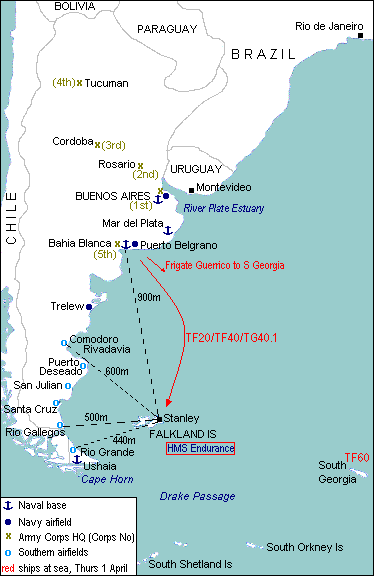

Image result for comodoro rivadavia air base falklands war
Comodoro Rivadavia air base was used in Argentine operations
Credit: naval-history.net

Other explanations

Why were Noticias Argentinas and El Patagónico closed?

There is the British MoD's apparently straightforward explanation: NA had published Radio Atlantico del Sur's list of Argentine POWs.

But there are other suggestions.

At the time (6 June 1982), The New York Times reported an editor at El Patagónico as saying: "There are guesses. It might have been some photographs or maybe a cable from June 1 that we published on June 2 saying that the air shuttle and movement of war material between Comodoro Rivadavia and the Malvinas was functioning perfectly well.''

The NYT cited the English-language Buenos Aires Herald as reporting an editor at NA, Raul Garcia, as saying that the closure was a discriminatory move as ''other media carried the reports which seemed to have prompted this with even more details''.

Unfortunately, nothing more was said about what those reports might have been.

A 2015 study of the press in Comodoro Rivadavia during the war, by María Laura Olivares of the Universidad Nacional de Rosario, says El Patagónico and Noticias Argentinas were suspended over their reporting of the possibility that British Vulcan bombers had been stationed in Brazil. 

Such a report was just the type of story that the British – through the MoD's Special Projects Group (SPG) – might have spread as an unavowable rumour.

If such a rumour had gone on to be repeated by a media outlet, perhaps in Chile, Radio Atlantico del Sur might have aired it. (The Chilean media was a fruitful source for RAdS of negative reporting about Argentina's military position.)

Finally, the book The Falklands War, published by Britain's Sunday Times shortly after the war, says the temporary closure of Noticias Argentinas came after it "published a story alleging that supplies to the troops on the islands were less than adequate".

Noticias Argentinas recalls its closure

The news agency itself appears to be unable to resolve the mystery. 

An article – headlined "The day that Noticias Argentinas had to go underground" – written in 2010 by Fernando Aguinaga and still on NA's website, recalls the agency's "unjust and incomprehensible" closure by the Federal Police in June 1982. 

Aguinaga makes no mention of Radio Atlantico del Sur and says the reasons for the closure "remain hidden". 

He suggests theories about NA giving the weather forecast for the South Atlantic or filing a dispatch about British military equipment.

Aguinaga says that, during NA's temporary closure, it "went underground" and continued to distribute its output by hand from a secret location in the Buenos Aires district of Avellaneda.

Conclusions

Perhaps only the discovery of documentary evidence in Argentine archives would finally settle the question of exactly what prompted Galtieri to issue his decree.

The British MoD's explanation may yet prove to be correct. 

Another possibility is that it was not one single incident that triggered the move but a steady drip of reporting by Noticias Argentinas that was irritating the authorities.

Other Argentine news agencies

In 1982, Argentina's TV, radio and press were served by no fewer than four national news agencies: 
  • Télam - government run
  • Noticias Argentinas (NA) - run by a group of private news outlets
  • Diarios y Noticias (DyN) - another privately owned service, which had only been launched the month before the invasion
  • Saporiti (ANS) - originally a private firm, by 1982 it had fallen under the control of the state intelligence service SIDE
All transmitted their output via radiotelegraphy. One of my jobs at BBC Monitoring during the war was to intercept RT signals from all four of them.

One day I'll write a blog post about that particular work. I wrote about another aspect of my work during the war in my post The Incident at Crowsley Park on the Night of 20-21 May 1982.

© 2018. Material may be reproduced if attributed to Chris Greenway and any original source.

Thursday, 16 August 2018

Radio Atlantico del Sur's signature tunes

Someone asked me last month on Twitter if I could identify Radio Atlantico del Sur's theme music.

Two pieces of music were used at the start of RAdS broadcasts, and Kian Sharifi kindly (and very quickly!) confirmed their identities.

The evening broadcasts began at 2300 GMT (2000 Falklands time) with an identification jingle consisting of a three-note "sting" (in the US radio industry it would be called a sounder) played on an organ, followed by the announcement "nueve setenta uno" ("nine seventy one"), referring to the station's shortwave frequency of 9.71 MHz (9710 kHz). 

The canned announcement was made by the station's sole female presenter, who used the on-air name Mariana Flores.

After that ID jingle was repeated, the station played "Treasure of San Miguel" by Herb Alpert & the Tijuana Brass (written by Roger Nichols and released in 1967). 

Some way into this, a presenter would make a brief live announcement to identify the station, give its transmission schedule and say that programmes would start in a few minutes.

The next piece of music played was "Argentina" by the group Conquistador, written by Hans van Hemert and Piet Souer to support the Dutch team during the 1978 football World Cup in Argentina. It's played on flute, guitar and conga drums.

During this, the presenters would preview some of the key points of that evening's broadcast.

The opening sequence described above lasted five minutes.

Listen to the music

A studio recording of the first 90 minutes of the Radio Atlantico del Sur broadcast on 20 May 1982, including the opening music, can be found on Jonathan Marks's website.

Were these good choices as the theme music for the station? They certainly met the main criteria for any signature tune, being distinctive and memorable.

They were also "shortwave friendly" – wind and percussion instruments generally coming across well through that medium.

© 2018. Material may be reproduced if attributed to Chris Greenway and any original source.
Friday, 10 August 2018

Mariana Flores — Britain's psychological weapon against the Argentine forces

Unlike Axis Sally, Tokyo Rose or Argentine Annie she had no nickname, her real name remains unknown and there’s no known photo of her....

Disclaimer: I was employed by the BBC at the time of the 1982 war, and continue to be so. However, this is an entirely personal blog post, reflecting only my views. 

Acknowledgements: I must thank Alejo Miguel Díaz, whose 2016 academic thesis Las Operaciones Psicológicas en el Conflicto del Atlántico Sur ("Psychological Operations in the South Atlantic Conflict") presented at the army university in Buenos Aires is a rich resource for anyone researching Radio Atlantico del Sur. The thesis has a section dedicated to the Pausas Sentimentales, which I am happy to acknowledge as a key source for this post.

I continue to be grateful for the encouragement from my Argentine friend Adrian Korol; and to professional researcher Lee Richards and his excellent website PsyWar.Org, without which I would probably not have started this blog last year.

(Update: This article was written in 2018. The section below on "Who was Mariana Flores?" was updated in May 2022.)

Mariana Flores and her "Pausas Sentimentales"

A regular feature of Radio Atlantico del Sur's output was its Sentimental Breaks (or Interludes) ("Pausas Sentimentales").

In each Sentimental Break, the station's sole female presenter – who used the on-air name Mariana Flores – would dedicate some lines of poetry and a record to named individuals said to be among the Argentine forces on the islands. 

Flores put on her most empathetic manner to do this. For RAdS's producers, it was key that the segment be presented by a voice with which the target audience could form an emotional connection. [1]

A written summary in the MoD files of the opening of the first day's RAdS broadcast put it bluntly: Sentimental Break was hosted by an "attractive girl presenter".

In his thesis, Alejo Miguel Díaz says Mariana Flores cultivated an ambiguity in how her (exclusively male) target listeners would see her, depending on their age, family circumstance and inclination: 
[She] set her voice in a gentle way, between mother and confidant, so as to awaken in the audience the feeling of being in front of a beloved and missed woman: a mother, a wife or a friend.
Psychological intent and technique

The sole aim (unspoken, of course) of the Sentimental Breaks was to demoralise the audience.

This was done across all of RAdS's output by reinforcing feelings of homesickness and unsettling the listener through an implicit but regular reminder of his predicament – he was a long way from home, isolated, facing a determined, well-equipped and well-trained enemy, and without hope of reinforcement or relief. (By the time RAdS was launched the islands were under a British air and sea blockade.)

Díaz notes the subtlety of Mariana Flores's approach. While speaking "in a gentle way", to gain the listener's attention, there was also "a hint of coldness in the intonation".

This reminded the listener of his hopeless situation and was in line with the first of the two aims that RAdS had formally set itself, to persuade Argentine troops to "consider positively the benefits of surrendering". (The other objective was to increase any inclination to "hesitate before firing on British troops".) 

Having seduced the listener with her sympathetic tone, Mariana let him down with cold comfort. 

With luck, RAdS's producers must have hoped, an Argentine soldier would feel miserable at the end of her little interludes – but not of course blame Mariana for that.

Examples of three Sentimental Breaks

Each Sentimental Break lasted just a few minutes. They went out every half an hour or so during each broadcast.

Three Sentimental Breaks can be heard in a studio recording of the first 90 minutes of the RAdS broadcast of 20 May 1982, on Jonathan Marks's website. 

On the recording's timeline, the three examples can be heard at 00:23:20, 00:49:50 and 01:21:05. 

Flirting on the airwaves

In this particular broadcast (the day after the station was launched), the two main presenters introduce themselves as Francisco Marín and José Miguel Antonov. 

In the first Sentimental Break of the evening (at 00:23:20 on the recording), Francisco Marín engages in some on-air flirting with Mariana Flores as he introduces her segment:
Francisco: The programme is called La Pausa Sentimental with Miss Mariana Flores. And here is the señorita again. How are you, Mariana? 
Mariana: Very well, Francisco, thank you. How are you? 
Francisco: I'm very well. But you are pretty, as always. [Mariana wordlessly acknowledges the compliment.] Hey, I think our audience has been waiting for you since we finished yesterday at 2300, because your dedications and your verses were magnificent. [2]
Mariana: Thanks. 
Francisco: Look, I hope you have more tonight.
Mariana: I hope so...
Mariana then reads a poem by the Spanish writer Federico García Lorca (1898-1936) which she says is from all the Argentine women "who regret being without husbands, sons or boyfriends" (in other words, because they are, most unfortunately, with the forces on the islands, and no doubt as unhappy about that as their womenfolk are). 

She ends this particular Sentimental Break by playing Julio Iglesias singing De niña a mujer (From girl to woman). Díaz notes that this song would have been intended to resonate with an older listener, perhaps an officer or a senior NCO, who might have a teenage daughter.

A mistake in translation

For the evening's second outing of Sentimental Break (at 00:49:50), Mariana is introduced in a rather more restrained fashion by the other main presenter, José Miguel Antonov.

It is in this segment that she makes a brief but serious mistake. 

After José Miguel's introduction, she reads some more poetry "for all of you in the Malvinas" and then introduces the song A Little Peace. 

This had been the winner of that year's Eurovision Song Contest, which had taken place the previous month and where it had been the West German entry, sung in German as Ein bißchen Frieden.

An English version of the song is then played (chorus: "A little loving, a little giving, to build a dream for the world we live in, a little patience and understanding, for our tomorrow, a little peace"...).

A good choice of song to undermine any martial ardour in the listener and, understandably, Mariana introduces the English-language disc by giving its title in English. But she then makes a homophonic error when translating its name into Spanish:
Y ahora, dedico una canción que se llama A Little Peace, un pedazo chico.
In short, rather than translating A Little Peace as "un poco de paz" she says "un pedazo chico" (a little piece).

It is perhaps unfair to highlight such a passing error, made on live radio (station manager Neil ffrench-Blake was insistent that all of RAdS's broadcasts be made live) in the early hours of the morning (almost 1 a.m. London time) by a young volunteer who possibly had no previous broadcast experience.

Dedication to a fictional lieutenant?

In the third outing of Sentimental Break that evening (on the recording at 01:21:05) you can hear Mariana send greetings to a second lieutenant, whose name she is careful to enunciate as Juan Esteban Olmedo Zigorraga, before her reading and musical dedication.

But did such an officer exist?

A listener's anecdote

Writing on a radio hobbyists' website in 2002, a shortwave listener in Brazil, Sérgio Dória Partamian, reminisced about Mariana Flores and her Sentimental Breaks.

Presumably recalling his own memories of listening twenty years earlier, he said Flores would suggest that "while the Argentinian soldiers suffered difficulties, their captured commanders would be amusing themselves with British women".

Assuming that Partamian's memory was correct, this was a classic demoralisation technique, used by both the British and Germans in the second world war: hinting that while the combat soldier endured his lonely hardships at the front, his more fortunate compatriots – civilians and senior officers back home, or those lucky enough to have been captured by a decent enemy – enjoyed an easier life.

Who was Mariana Flores?

We don't know. The identity of her Argentine counterpart, Silvia Fernández Barrio, who broadcast to British forces anonymously as "Liberty", became public knowledge soon after the war, and Silvia Fernández has been happy to talk about her secret work in 1982.

But Radio Atlantico del Sur's presenters – said to have numbered nine in total, with all except Mariana being male and serving members of the British armed forces – remain known only by their on-air pseudonyms. Along with Mariana they included Francisco Marín and José Miguel Antonov (both mentioned above), Mario Santana and the station's resident military commentator, Jaime Montero.

Perhaps this makes them the perfect psychological warriors. For eternity they will exist only as voices on the radio, that most ephemeral of media. 

Update in May 2022: In a TV documentary aired in April 2022 to mark the 40th anniversary of the war, a retired British major, Terence Scott, confirmed that he had played the part of "Jaime Montero" and that "Mariana Flores" was a cousin of his. 

Further listening

Thanks to Adrian Korol for pointing me towards a complete recording of Sentimental Break's theme music. 

Notes

[1] Contrary to misunderstandings at the time – including within the British government – and since, the sole target audience for Radio Atlantico del Sur was Argentine forces in the islands and, to a lesser extent, in their mainland coastal bases. It did not target an Argentine civilian audience, still less one elsewhere in Latin America (though the nature of shortwave meant that it had listeners in those places).

[2] Radio Atlantico del Sur's evening broadcasts went out at 2000 to 2300 local time (2300-0200 GMT). When Argentine forces invaded the Falklands on 2 April 1982 the local time in the islands was 4 hours behind GMT. The occupying forces decreed that local time in the islands would be the same as that in Argentina, which was 3 hours behind GMT. As an act of civil disobedience, the islanders refused to recognise the imposed time zone. Throughout this blog, I use the Argentine-imposed time zone (GMT minus 3) as Radio Atlantico del Sur was only targeting Argentine troops, and announced that time on the air.

© 2018. Material may be reproduced if attributed to Chris Greenway and any original source.
Tuesday, 7 August 2018

Did you work for Radio Atlantico del Sur?

Checking the settings on this blog, I spotted that they were configured only to allow comments from users with Google accounts. I changed that to allow anyone to post comments, including anonymously.

I would particularly welcome comments that correct any inaccuracies in any of my posts.

I'd also be very pleased to hear from anyone who was connected in any way with the operation of Radio Atlantico del Sur. Confidentiality is assured. I've chosen not to name in this blog anyone who was intimately associated with RAdS unless their identity is already published (to date, the only name in that category is that of the late Neil ffrench-Blake, the station's civilian manager) or they have confirmed to me that they are happy to be named.

Along with ffrench-Blake, I've come to know the names of six other people who worked on RAdS. A check through my blog will show that I've refrained from naming any of them. Four of the six were military officers, whose full names appear in MoD documents now released to the National Archives, but as I don't know how they or their families feel about that I've only referred to them by the initial of their surname and their rank at the time of the 1982 war. They were Colonel S. (who headed the MoD's Special Projects Group, SPG, for most of the war and was key to persuading his superiors to approve the radio project), Colonel L. (his successor), Lieutenant-Colonel B. and Squadron-Leader G. (who both worked directly with ffrench-Blake).

Last December I was contacted by one of the civilians who worked on RAdS, and was very happy to host his reminicences on this blog, naming him only as "A".

© 2018. Material may be reproduced if attributed to Chris Greenway and any original source.

Monday, 5 February 2018

Pinpointing the location: "on the left at the top of the stairs"

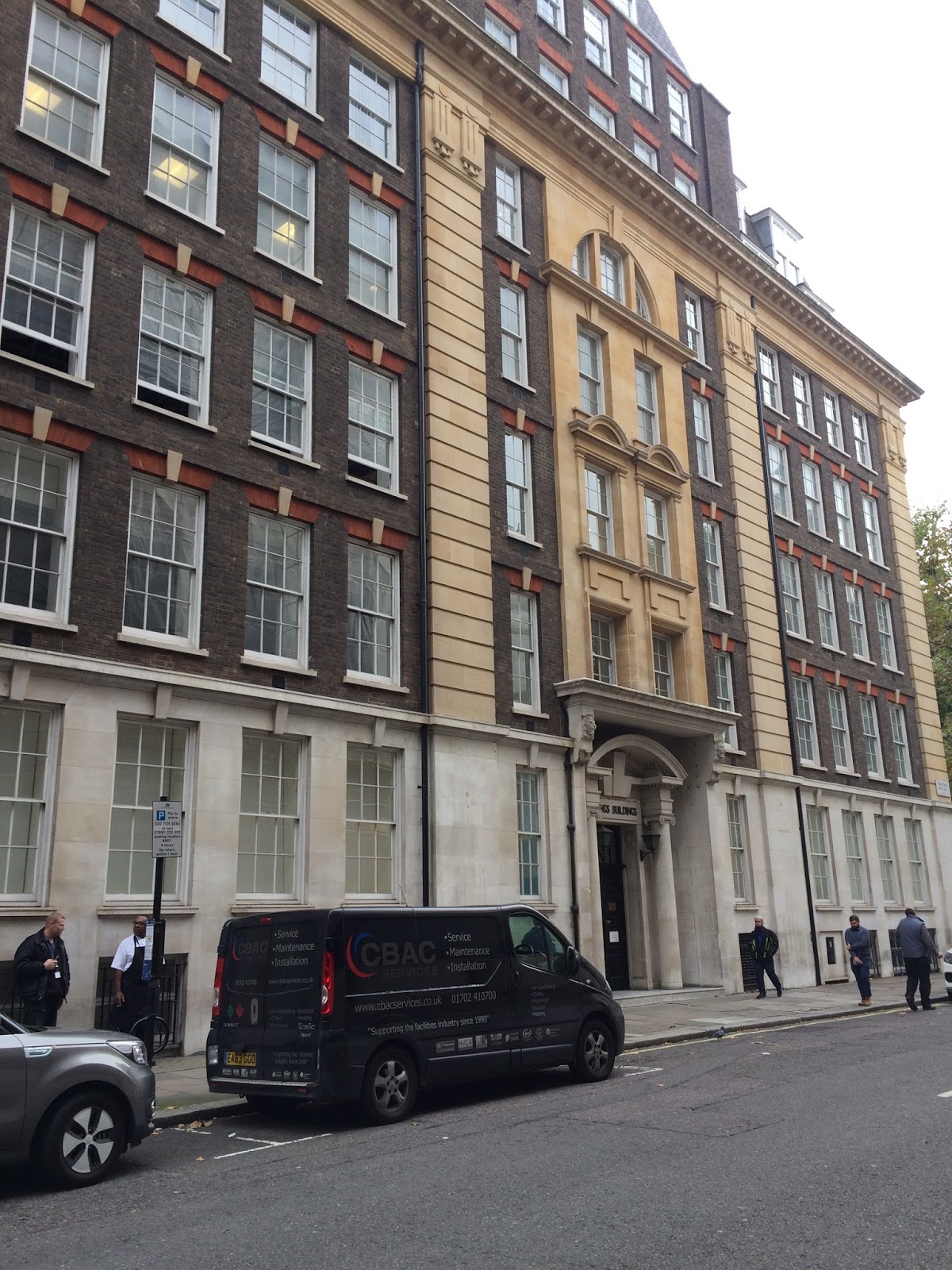
For those who value a precise determination of the site of historical events, this is an update on Kings Buildings, the location of Radio Atlantico del Sur's offices and studios.


I illustrated my November 2017 post The Secret is Revealed with this photo showing both sides of Kings Buildings in Westminster, less than five minutes walk from the Houses of Parliament.

The main entrance to Kings Buildings is on the side of the block in Smith Square, on the right.

When I visited Kings Buildings last October and took this photo, I found that only the Smith Square door was still in use.

The other entrance was closed. It's just visible on the far left of the picture, around the corner in Dean Stanley Street.


In his January 2018 guest post on this blog, Radio Atlantico del Sur staffer "A" confirmed my guess that, in 1982, the Dean Stanley Street entrance to Kings Buildings was open and was used by BFBS, which had lent some of its accommodation to RAdS.


"A" wrote: "We arrived at the then BFBS (British Forces Broadcasting Service) premises at Kings Buildings in Dean Stanley Street and went to a small suite of offices on the first floor on the left at the top of the stairs. It had 'Media Assessment Team' on the door."


This next photo shows the Dean Stanley Street side of Kings Buildings today. Smith Square is on the extreme right of the picture.

The Dean Stanley Street entrance (now closed) can be seen.

This is the door that "A" would have gone through on the morning of 19 May 1982, before he walked upstairs to the first floor (the second floor for American readers) and turned left for the offices of the "Media Assessment Team" (the cover name used by RAdS staff).

"A" recalls that the BFBS studios used by Radio Atlantico del Sur were in the basement of this building. Would any former BFBS staffer like to confirm that?


© 2018. Material may be reproduced if attributed to Chris Greenway and any original source.

Thursday, 25 January 2018

Guest blog: A member of Radio Atlantico del Sur’s staff recalls his work

Last month I was contacted by a fellow broadcasting professional who said he had worked on Radio Atlantico del Sur and had read my blog. There was no doubt as to his authenticity as he got in touch not via the blog, but privately via a trustworthy intermediary known to both of us. We met a couple of weeks later and enjoyed swapping our recollections of 1982. 

He has now written down some of these memories for this blog. He wishes to remain anonymous, and just be known as “A”:

In May 1982 I was part of the management team at a commercial radio station in southern England.

Some years earlier, when working freelance for the BBC, I had been sent to interview Neil ffrench-Blake about one of his business ventures. It was the start of a lifelong acquaintance.

I know from my diary that Neil came to my house on the evening of Monday 17th May 1982. He discussed the Falklands War and the radio station he was putting together to broadcast to the Argentinean invaders. I remember he asked me if I was patriotic.

The following day Neil called me at work and said he would shortly be talking to my boss, “T”. He told me that T would be receiving a phone call from Peter Baldwin, head of the Independent Broadcasting Authority (IBA), which regulated commercial radio in the UK at the time. I was to go in to see T in 10 minutes time to ask for leave. “T will say ‘yes’,” said Neil.

This I did and sure enough T said “yes”, though he raised an eyebrow since he clearly did not know where I was going or what I would be doing.

On Wednesday morning, 19th May, at 7 am Neil drove to my house and picked me up. I had no idea where I was going or what I would be doing or even when I would be back. I merely knew it was to do with a Falklands radio station. As we drove into London, Neil explained that he had put a team together to broadcast to the Argentinean soldiers and had “acquired” two Argentinean-Spanish speaking military people to do the broadcasts, as well as a small back-up team.

We arrived at the then BFBS (British Forces Broadcasting Service) premises at Kings Buildings in Dean Stanley Street and went to a small suite of offices on the first floor on the left at the top of the stairs. It had “Media Assessment Team” on the door. The story was that we were assessing the various media reports on the war for the Ministry of Defence.

While our offices were upstairs at Kings Buildings, I remember the studio as being in the basement.

My role was to write suitable news stories, based on the news of the day, but always upbeat and pro-British, though not excessively so. These were then translated into Spanish and broadcast. One of the stories that I wrote and was broadcast was later queried by a senior Ministry of Defence official who thought I was revealing classified information. I was able to prove that I had taken the information – about some form of weapon – from publicly available material that had in fact been broadcast by the BBC.

Our first broadcast was that evening (19th May) at 11 pm. Neil had chosen a lilting theme tune, the sound track from a film. We were excited when we were able to tune in to the repeater station on Ascension Island and hear the echo of our broadcast, so we knew it was going out.

I had a typewriter (this was before computers were at all common) and I rang Independent Radio News (IRN), where I had previously worked, to ask them for a stack of “no carbon sets”. These were the A5 sized blocks of 3 sheets of coloured paper (yellow on the top) which IRN used for their news bulletins. This had the advantage that 3 copies of any news story were produced which allowed for one copy to be translated, another to be checked by the director (to ensure it was "on message") and the third filed.

IRN seemed surprised at my request, especially since I couldn’t tell them what the sets were for, but made up some story about my station needing some and that I happened to be able to arrange to collect them.

One of the military Spanish speakers needed his dictionaries which were somewhere on the South Coast. A military car was sent to collect them at once.

I remember the staff as being quite few – mainly male with at least one woman officer. We had a small kitchen, with a sign saying “MAT’s café”, where we made tea and coffee.

I had an MoD pass and may have gone to the MoD building in Whitehall a few times for meals. I also had a car pass and commuted from home every day, parking my car on Horse Guards Parade.

I worked for probably three quarters of the days of the remainder of the war and remember the last day when news of the cease-fire came through. We felt both elated at, hopefully, having played some small part and at the same time a sense of let down, or “end of term”. Everything was quickly cleared up and soon there was nothing left to show of our time there.

We had ordered T-shirts and sweat-shirts, with our slogan of “Bringing Truth to the Front” on them. I remember that mine were sent on to me later since they had not arrived by the time the war ended – I still have them.

And so my work at Radio Atlantico del Sur came to an end. There was an odd follow-up to it many years later - but that must be for another time.

Many thanks to A for his fascinating account. Alongside Neil ffrench-Blake’s memoirs, they form the only published first-hand records of work at Radio Atlantico del Sur. Two points in A’s account are worth noting. He confirms Neil ffrench-Blake’s utterly central role in the RAdS story. And A’s recollection that the station used a basement studio in BFBS’s building may be the origin of the rumour that it had broadcast from the basement of the Foreign Office. (I noted this rumour in my blog post The Secret is Revealed.)

I will be very happy to host guest blogs by other former members of Radio Atlantico del Sur’s staff. As with A, I can guarantee that anonymity will be preserved.

© 2018. Material may be reproduced if attributed to Chris Greenway and any original source.

Saturday, 30 December 2017

The Requisitioning of Sender 302 — a detailed look at the controversy

Disclaimer: I was employed by the BBC at the time of the 1982 war, and continue to be so. However, this is an entirely personal blog post, reflecting only my views.

This article is about the use by the British Ministry of Defence (MoD) of a requisitioned transmitter at the BBC Atlantic Relay Station on Ascension Island to beam Radio Atlantico del Sur's signal to its target audience. I took a first look at this controversy in a previous post. 

For background to this article, new readers of this blog may wish to read the post MOONSHINE - A story of psychological warfare. (MOONSHINE was the MoD's codename for Radio Atlantico del Sur.) 

The key transmitter 


In theory, RAdS could have used shortwave transmitters in the UK. Their signals could reach the Falklands. But it was essential that RAdS had the strongest possible signal, to have the best chance of being heard with reasonable quality on the simple sets that Argentine troops might have packed in their kit bags.
And as it was expected that RAdS would be jammed (as indeed turned out to be the case), only the best possible signal would do.

So, from the very start of the planning for RAdS it was assumed that one of the Ascension transmitters would have to be used.

The criticism

RAdS's critics – in 1982 and since, not least in the Foreign Office (FCO) – have claimed that the MoD's operation therefore deprived the BBC of a valuable transmitter for its own broadcasts to Latin America and Africa at a time when it was particularly important for Britain that the BBC External Services were heard as well as possible. [1]

Sender 302

In BBC-speak, shortwave transmitters are "senders", and each one has a unique "S" number. For example, at the time of the Falklands War the 12 senders at the BBC's transmitting station at Daventry, Northamptonshire, were numbered between S8 and S21 (S10 and S15 were no longer in service). Today, the sole remaining shortwave broadcast station in the UK is at Woofferton (straddling the Shropshire/Herefordshire border) where the 10 transmitters are numbered S81 to S84, and S91 to S96.

In 1982, there were four shortwave senders at the Ascension Island station: S301, S302, S303 and S304. They were identical and had 250 kilowatts of output power each. This made them among the most powerful of all the BBC's shortwave transmitters at the time, whether at the five transmitting stations it used in the UK or at its other overseas relay sites in Antigua, Cyprus, Lesotho, Oman and Singapore.

The government would have to requisition a specific transmitter to carry Radio Atlantico del Sur. After consulting the BBC, it was decided that it should be S302.

The evening scheduling problem

Although Radio Atlantico del Sur was on the air in both the morning and evening, it was the latter broadcasts that were seen as the more important "because less of the audience is then likely to be involved in their military duties" as RAdS's planners put it.

The initial plan (circulated within government on 28 April 1982) was that the evening programmes would go out for four hours from 2000 GMT – i.e. at 1700 to 2100 Falklands time. [2]


This posed a considerable challenge, as evenings in May 1982 were busy times for the Ascension relay station. Each day the station had been beaming BBC World Service in English to Africa on at least one transmitter (and at times on all four of them) since early morning, and continued to do so on one frequency until 2245 GMT. From 2000 it was also airing WS English to Latin America. Then there were the evening foreign-language broadcasts to Africa: French at 1815-1915, Hausa at 1915-1945 and Portuguese at 2030-2115 GMT (all carried on two Ascension frequencies). There was the "Calling the Falklands" programme, the BBC's lifeline service for the islanders, at 2115-2200. And from 2200 there was the BBC Portuguese service to Brazil, followed at 2315 by Spanish for Latin America (both languages being aired on two Ascension frequencies).

Accommodating Radio Atlantico del Sur in this busy schedule would therefore have been very difficult before 2245 GMT. (The MoD had made it clear from the start of its planning that the sender would only need to be requisitioned for the hours that RAdS would be on the air. It would be free during the rest of the day for its regular service for the BBC.)

Possibly because of that difficulty, the planned timing of the evening broadcast was quickly changed, and within a week of the initial plan the MoD had modified its proposal by pushing back the start time by three hours to 2300 GMT.

This made things simpler for the BBC's frequency managers. By 2300 GMT, all BBC transmissions to Africa had ended for the day, and the vital "Calling the Falklands" programme was also safely out of the way.

What was left to occupy Ascension for the hours immediately after 2300 was using two transmitters to carry the BBC Spanish service and the remaining two to carry World Service in English to the Americas.

To accommodate Radio Atlantico del Sur, WS English lost one of its frequencies from Ascension. The channel that was dropped was instead carried by a transmitter in the UK. The BBC estimated that this would result in a "50 per cent loss in quality" in the target area on that particular frequency. It should be noted that WS English continued to be beamed to South America after 2300 GMT on a total of eight frequencies (one from Ascension, one from the BBC Caribbean Relay Station in Antigua and six from the UK).

Possible overnight schedule for each transmitter

Using my admittedly incomplete notes from 1982, my best estimation is that each transmitter at Ascension was scheduled as follows overnight:

Before 19 May:
  • S301 carries BBC World Service to the Americas at 2000-0230 GMT (on 15260 kHz).
  • S302 carries "Calling the Falklands" at 2115-2200 (on 15400), Portuguese to Brazil at 2200-2315 (on 15390) and then Spanish to Latin America at 2315-0315 (on 15390).
  • S303 carries "Calling the Falklands" at 2115-2200 (on 11820), Portuguese at 2200-2315 (on 11820), Spanish at 2315-0215 (on 11820) and English to South America at 0230-0330 (on 11750).
  • S304 ends carrying BBC World Service to Africa (on 6005 kHz) at 2245, then makes a frequency and aerial change (from east to west) to carry BBC World Service to the Americas at 2300-0230 (on 11750). 

After S302 was requisitioned on 19 May:
  • S301 ends carrying BBC World Service to the Americas at 2200 (on 15260 kHz), does a quick frequency change to 15390 kHz and carries Portuguese at 2200-2315 and Spanish at 2315-0315. Meanwhile, a transmitter in the UK takes over carrying WS English on 15260 from 2200 onwards.
  • The requisitioned S302 ends "Calling the Falklands" (on 15400) at 2200 and shuts down. It switches frequency to 9710 kHz (but stays on the same aerial) and comes on the air again at 2255 with RAdS's interval signal, prior to the start of programming at 2300.
  • S303 no change - schedule as above.
  • S304 no change - schedule as above.

The morning scheduling problem looked easier...

Accommodating the morning broadcast was simpler than the evening one, though again this was only after the original plan for the timing was changed.

In the early morning, after the overnight transmissions to the Americas had ended, all of Ascension's efforts were focused on Africa. As well as World Service in English (from 0300 GMT), there were the dawn transmissions in French (0430-0445, 0515-0545 and 0630-0700) and Hausa (0545-0600). By 0730 all four Ascension senders were carrying the WS in English to Africa: one on 11860 kHz, one on 21660 and two transmitters doubled-up to give 500 kW on 15400.

For an RAdS transmission starting at 0815 (as was the orginal plan) it was simply necessary to take Sender 302 off 15400 kHz (still leaving another transmitter radiating on that frequency).

Some listeners in Africa might notice a reduction of power on 15400, but they still had the alternative frequencies of 11860 and 21660 from Acension and four other frequencies (two from the UK and one each from the BBC relay stations in Cyprus and Lesotho).

... but for the Voice of America problem

So far, so simple. But there would be a problem if the RAdS transmission continued beyond 1000 GMT. For this would mean a clash with the Voice of America's (VOA) morning transmission in Portuguese to Brazil, which was carried on two Ascension transmitters between 1000 and 1100.

The relay of the VOA by Ascension was part of a swap arrangement under which some BBC broadcasts to Latin America were relayed by VOA transmitters in the USA.

Upsetting the arrangement with the VOA would therefore cause embarrassment to the BBC, and possible irritation in Washington.

The planned timings for the morning RAdS broadcasts went through several changes. At one point a two-and-a-half hour broadcast at 0815-1045 GMT was envisaged. By the time the proposal for Project MOONSHINE was put to the War Cabinet this had been reduced slightly to 0830-1030, and when the MoD issued its 19 May press release announcing the start of broadcasts there had been a further reduction to 0815-0945.

When the morning broadcasts eventually began on 28 May they were at 0830-0930. So, there was no clash with the VOA.

The requisitioning

Someone in government had to write to the BBC to give formal notice that one of its Ascension transmitters was being requisitioned. There was an argument in Whitehall about which ministry should do this. Up to that time it was assumed that in the case of the BBC's domestic service transmitters it would normally be the job of the Home Office. For the BBC External Services the expectation was that the Foreign Office would take responsibility for the task.

But the FCO, which had opposed the setting up of the RAdS ever since Project MOONSHINE was first mooted, rejected the suggestion that it should requisition the Ascension transmitter and wanted the MoD to do the deed instead.

(For more about the arguments between the FCO and the MOD over Radio Atlantico del Sur, see my post "The War Cabinet is invited to agree".)


By 13 May the FCO had been working for over a fortnight to stop RAdS from taking to the air, but seems to have realised that it was likely to lose this particular Whitehall battle. That day, Keith MacInnes, head of the FCO Information Department and a key player in the Foreign Office's agitation against RAdS, wrote to the MoD to say:

[...] this is a special case and it is our view that entire responsibility for the operation should rest with the Ministry of Defence.
In other words, the FCO wanted to cover itself should RAdS prove to be a fiasco, and so the MoD would have to requisition the transmitter itself. This was although a Mr Chamberlain, an FCO legal adviser, had said in an internal memo on 6 May that "it would be better for the letter [to the BBC] to go from the FCO".

So, on 19 May, the day after the War Cabinet had agreed that Project MOONSHINE should go ahead, the Permanent Under-Secretary at the MoD, Sir Frank Cooper, wrote to Sir Ian Trethowan, Director-General of the BBC:

Dear Ian, 
In the circumstances of the present Falkland Islands operations, I am writing on behalf of the Secretary of State for Defence to say that Her Majesty's Government require the use of a transmitter number 302 at the BBC Atlantic Relay Station, between the hours of 0815 to 0945 and 2300 and 0200 GMT, from 2300 GMT on 19 May 1982 until further notice. [3]
2. In accordance with Article 19 of the Licence and Agreement of 2 April 1981 between Her Majesty's Secretary of State for the Home Department and the British Broadcasting Corporation, the Corporation are hereby directed to permit the use of the said transmitter by Her Majesty's Government for the periods stated in the preceding paragraph.
3. I should be grateful if you would acknowledge receipt of this letter.
Yours sincerely,
Frank Cooper
Sir Ian replied:
Dear Frank,

I am in receipt of your letter of today's date informing me that Her Majesty's Government require the use of transmitter number 302 at the BBC Atlantic Relay Station at the specified times of day until further notice.
We will, of course, comply.
Yours,
Ian
And when it was all over, after Argentine forces surrendered late on 14 June, Sir Frank wrote again to the BBC on 16 June:
Dear Ian,
Further to my letter of 19 May, I am writing again on behalf of the Secretary of State for Defence to inform you that following the surrender of the Argentine forces on the Falkland Islands, Her Majesty's Government will no longer require the use of Transmitter Number 302 at the BBC Atlantic Relay Station from 1800 GMT on 16 June 1982.
2. I should like to take this opportunity to express my thanks for the BBC's prompt action in making the transmitter available in the exceptional circumstances of the Falkland Islands operation.
Yours sincerely,
Frank Cooper

Conclusions

The BBC coped remarkably well with the loss if one of its Ascension transmitters for four hours a day. No BBC transmissions from Ascension in foreign languages were lost, nor was there any interruption to the important "Calling the Falklands" programme or the relaying of the British Forces Broadcasting Service (BFBS) programme for the Task Force. The relaying of the Voice of America was also unaffected.

The small price of a loss of power on one (of three) Ascension frequencies carrying BBC World Service for Africa outside prime listening hours, and on one frequency (of many) carrying WS English to South America, seems one well worth paying to get Radio Atlantico del Sur on the air. 

Notes

[1] What is now known as the BBC World Service (operating in English and many other languages) was in 1982 still referred to as the BBC External Services – and in internal BBC bureaucracy as External Broadcasting (XB). At that time, the "World Service" name was reserved solely for the service in English. This distinction was abandoned in 1988 when the "External Services" name was dropped and all international broadcasting by the BBC came under the World Service brand.

[2] When Argentine forces invaded the Falklands they announced that local time in the islands would be the same as that in Argentina, which was 3 hours behind GMT. Meanwhile, local time on Ascension is the same as GMT.

[3] The wording ("a transmitter number 302") suggests that whoever drafted this letter assumed that "302" was a type of transmitter, rather than the designation of one individual sender.

© 2017. Material may be reproduced if attributed to Chris Greenway and any original source.