Showing posts with label Services Sound & Vision Corp. (SSVC). Show all posts

Wednesday, 22 November 2017

"The codeword for this operation is MOONSHINE"

Disclaimer: I was employed by the BBC at the time of the 1982 war, and continue to be so. However, this is an entirely personal blog post, reflecting only my views.

Acknowledgement: I continue to be happy to express my gratitude to professional researcher Lee Richards for making available a number of declassified files from the Ministry of Defence (MoD), the Foreign & Commonwealth Office (FCO) and the Cabinet Office relating to British information and psychological operations in the Falklands War, including MOONSHINE, the codename for Radio Atlantico del Sur. Material from these files forms the basis for this blog post.

"SPG 020" and "Paper No 6"

On 28 April 1982, the colonel in charge of the Ministry of Defence's Special Projects Group (SPG) circulated within government a document called "Annex A to SPG 020" (or SPG 020 for short as I call it). 

SPG 020 set out the plan to set up a shortwave station, Radio Atlantico del Sur, to broadcast to Argentine forces in the Falklands. A revised version of SPG 020 was circulated the following day.

SPG 020 ran into immediate opposition from the Foreign Office. In an attempt to answer the FCO's objections to the proposed radio station, the SPG issued a further revised document on 3 May.

This document  "Special Projects Group - Paper No 6"  also added to the plans given in SPG 020, notably on the financial costs of using a requisitioned transmitter at the BBC's Ascension Island relay station, and the implications for the BBC's own services of losing the use of one of the four Ascension transmitters at certain times of day.

I have transcribed the text of "Paper No 6" below. Copies of the original document can be found in the National Archives in MoD file DEFE 25/502 and FCO file 26/2449.

[Explanations that I have inserted into the text below are in italics and between square brackets.]

SECRET

ATTACHMENT TO
COS(Misc) 192/742/1

SPECIAL PROJECTS GROUP  PAPER NO 6

PROJECT MOONSHINE – RADIO STATION

BACKGROUND

1. SPG has been given direction from Ministerial level to find every suitable means of supporting OP CORPORATE [the overall codename for British military operations against Argentina] through the media. This paper proposes a method of broadcasting to the South Atlantic by a means which will be separate from BBC broadcasting. We know that the Junta is increasingly seeking to suppress the truth. Now the TEZ [Total Exclusion Zone the British sea and air blockade of the Falklands] is established the garrison will receive no newspapers. Thus we believe that broadcasts carrying factual reports will be useful in bringing home to the garrison the truth about their predicament.

2. The proposed radio station could also be used to pass information and, perhaps, instructions prior to an assault, to the Islanders. We know that both the Argentine and Island populations commonly posses short wave transmitters [sic] and listen on this wave. The debrief of a Falklands woman policeman indicates that soldiers of the garrison have transistors and listen to them.

AIM

3. This paper seeks agreement in principle, and financial authority, for the setting up of a radio station to broadcast to the South Atlantic. The codeword for this operation is MOONSHINE.

CONCEPT

4. The BBC Spanish language service is a Radio 4 equivalent servicing a wide Latin American audience. Our station would be a commercial radio equivalent appealing to a lower social level, in particular soldiers of the garrison, their families and those concerned with mainland based facilities. It will broadcast light music interspersed with news and world opinion taken from other radio and press coverage.

5. The radio station would use a BBC transmitter in Ascension and the studios of Services Sound and Vision Corporation (SSVC) Kings Buildings London. [The SSVC was, and is, the parent organisation of the British Forces Broadcasting Service, BFBS.] Broadcasting could start almost at once.

MANNING

6. We have identified a freelance consultant [Neil ffrench-Blake] with wide experience of BBC and commercial radio who has assisted with our feasibility study and who is willing to act as Station Manager. He will need 2 civilian assistants. [SPG 020 said the two civilians in addition to ffrench-Blake would be a Spanish-speaking copy taster  "BBC is seeking a suitable man from the Monitoring Service"; and an engineer  "we have an ex-Sergeant RAF radar engineer in mind. He is well known to Mr ffrench-Blake".] We have found 3 serving officers [in the British armed forces] of Argentine background, and a further 2 officers who are satisfactory Spanish speakers. They have been tested by an Argentine linguist who assures us that between them they are well qualified to fill the editor and announcer posts. (Annex A).
[Annex A was an organisation chart for the team, showing three civilian staff  the station manager, the copy taster and the engineer  and nine military personnel, along with one SSVC engineer.] 

7. The senior serving officer of the team will be Sqn Ldr [Squadron Leader] G. of Psy Ops [Psychological Operations] Section, JW [Joint Warfare] Wing NDC [National Defence College] currently a member of SPG. He will be responsible for ensuring that the station conforms to MOD policy. In addition to the announcers, Int [Intelligence] Corps can provide useful additional staff for processing English language material. [1] 

PLAN

8. Transmitters. There are suitable transmitters, owned by BBC (but bought with FCO funds), in Ascension [known formally as the BBC Atlantic Relay Station]. The penalty involved in using one [of the four transmitters in Ascension] for the proposed station for certain hours of the morning and evening (local time) are given at Annex B. In brief no programme would be lost, but power would curtailed on one of the English language frequencies to the area. In the morning period the Voice of America (VOA) [in Portuguese] to Brazil would lose one of two frequencies loaned by BBC Ascension. 
[In the end, the timing of RAdS's morning broadcasts was set at 0830-0930 GMT and so the VOA broadcast to Brazil, at 1000-1100 GMT, was unaffected.]

9. Frequencies. Because the radio station must be kept entirely separate from the BBC we must not use British frequencies. We are advised by the BBC, however, that frequency poaching is common and that BBC can probably identify for us a frequency meeting the following criteria:
 a. Optimum reception in the target area.
 b. Allocated to a minor third-world country (Argentina?) whose protests may be safely disregarded.
 c. As close as possible to an existing Argentine service.
[In the end, Radio Atlantico del Sur used 9710 kHz for its evening broadcast and 9700 kHz for the morning one. Both were close to 9690 kHz, which was used during the 1982 war by various stations in Argentina.]

10. Studios. Studio facilities can easily be made available in Kings Buildings close to the SSVC whose studios can be used outside working hours without interference with normal work. This will be adequate at least in the early stages. If and when we start morning broadcasts we are confident that a satisfactory arrangement can be made.
[See my post The Secret is Revealed: Radio Atlantico del Sur's studio.]

11. Programme Content. We envisage broadcasting for up to 5 hours daily 0530-0730 and 2000-2300 local [equivalent to 0830-1030 and 2300-0200 GMT; the proposed times of the morning broadcast were subject to discussion and revision, and when they eventually began on 28 May they were at 0530-0630 local time, 0830-0930 GMT]. The first objective will be to gain and hold the attention of the target audience. This should be achieved by the use of popular and familiar music combined with a relaxed and informal style of presentation. The news output will be politically and militarily uncontentious. Opinion will be limited to attributed reports from other agencies. Material will be drawn from the following sources:
 a. Ethnic music.
 b. Telex news services.
 c. Extracts from the Argentine press, transmitted on a daily basis by the British Embassy in MONTEVIDEO [Uruguay]. This may well entail an increase in FCO staff in the Embassy, but such a service will have an important intelligence spin-off. The matter is being raised with the FCO informally. [In his memoirs, RAdS's civilian manager, Neil ffrench-Blake, said the FCO withheld cooperation from him, including refusing to provide him with copies of Argentine newspapers. Instead, he had to use a private courier service from South America.]
d. FCO extracts of world-wide press coverage.
e. Intelligence debriefs of evacuees from the Falkland Islands.
f. BBC internal news services.
g. BBC Monitoring Service reports.
h. Major US and European newspapers.
i. Dedicated telex to BBC news room.

SECURITY

12. We propose that the station should call itself RADIO ATLANTICO DEL SUR (Radio South Atlantic). [2] We would seek for as long as possible to avoid any confirmation that it is British sponsored. In particular we will seek to keep secret the location of the studio. We propose that the broadcasting team in Kings Buildings calls itself the Media Assessment Team (MAT). Within MOD the operation will be referred to as 'MOONSHINE'. Some unvetted civilians will have to be employed. We believe that the only practical step will be to ask them sign the OSA [Official Secrets Act]. Their knowledge of classified matters will be limited to knowledge of the station itself. BBC staff in Ascension will be aware of what is going on.

13. Once it becomes well known that the broadcasts emanate from Ascension we might well be forced to admit that it is a government sponsored operation in order to protect the BBC. But the aim of the service is defensible. Particularly in that it could result in a saving of lives.

COSTS

14. At this stage it is very difficult to quantify costs. We envisage an initial capital outlay of £1,500 for installation of lines, initial telex costs, records, Spanish language books, directories, etc. We are advised that it will be impractical for the broadcasts to be other than live so civil staff will need hotel accommodation in London. These costs are likely to be:
Station Manager  £450 + VAT (for 70 hrs) per week (as paid previously by FCO) [presumably this is what ffrench-Blake was paid in his previous secret work for the government]
Copy Taster – £300 (reimburse employer) per week
Engineer – £300 (reimburse employer) per week
Overnight allowances  1 @ £47.55 per night
(FCO rates) 2 @ £31.55 per night
[When the armed forces' chiefs of staff considered this paper on 4 May they said: "The overnight allowances at paragraph 14 should be examined and a more modest proposal inserted."]

TOTAL £1,900 approximately per week

15. Transmission costs. The cost of running transmitters in Ascension is £500 per hour. The only period when we might run the transmitter, that is not now running at FCO expense, is 0930-1030Z [GMT] (cost £3,500 per week). If we were to broadcast for 5 hrs per day Cable and Wireless charges for transmission to Ascension would be £1,250 per day or £8,750 per week. [The proposed Cable and Wireless feed, which would have been by satellite to the C&W station on Ascension, was not used. Instead, RAdS's signal was fed to Ascension via BT's Rugby Radio Station, as explained in my post The Incident at Crowsley Park on the Night of 20-21 May 1982.] On this basis extra transmission costs amount to £12,250 per week. A saving of £5,250 per week could be made if we did not broadcast between 0930 and 1030Z (VOA times). [As noted in Paragraph 8 above, in the end RAdS's morning broadcasts did not clash with the VOA broadcast to Brazil.]

16. Total Costs. Telex service costs [for receiving teleprinted feeds from news agencies] are not known. An allowance of £1,500 per week for expenses such as this seems realistic. Thus total extra costs per week are estimated at:
For 3 hrs evening + 2 hrs morning £15,750
For 3 hrs evening + 1 hr morning £10,500

[After the war, the total cost of the four weeks of broadcasting by Radio Atlantico del Sur was said by the MoD to have been about £40,000 (equivalent to around £140,000 in 2017 prices), in line with the above estimate for broadcasts of three hours in the evening and one hour in the morning. These were "extra costs", not including the salaries of the armed forces' personnel who worked on the station (as they would have been paid in any case) or the cost of running the Ascension Island transmitter (as it would already have been on the air at government expense if it had not been requisitioned).]

FCO VIEW

17. This paper has been refined since we obtained an FCO view at official level. We now know more about the effects on BBC broadcasts. Our main counters to FCO reservations are:
 a. As proposed we believe that the BBC would be adequately distanced from MOONSHINE. Thus BBC credibility and reputation would not be damaged. We suggest that the pirating of a frequency is justifiable in the present circumstances.
 b. We believe that the station will provide a fully professional commercial-type service.
 c. We believe that there is a good chance that Argentine soldiers and civilians are likely to sample the short wave frequency and tune to our topical and entertaining service. The Argentines may even advertise it through denunciation.
 d. We consider that, even if branded by the Argentines as propaganda, such a service is most unlikely to be "counter-productive". We see it is as a comparatively low cost operation carrying negligible risk to the BBC, which could, in view of the Argentine temperament and the predicament of the garrison, contribute to the success of HMG [Her Majesty's Government] policy.

RECOMMENDATIONS

18. We recommend that authority be given:
 a. To requisition from the BBC a suitable transmitter for use during hours of broadcasting.
 b. To set up a radio station and start broadcasting on the lines set out above, for up to 5 hours per day. [When the armed forces' chiefs of staff considered this paper on 4 May they said this sentence should read: "... for not less than 3 and up to 5 hours per day".]
c. For expenditure as detailed in Paragraphs 14 and 16 above, as part of MOD Operation CORPORATE costs.

Annexes:
A. Organisation of Media Assessment Team (MAT). [Staffing of the team see Paragraph 6 above.]
B. Feasible Hours of Broadcasting. [This looked at the implications for BBC and VOA services of requisitioning one of the Ascension transmitters at specific times of the day. I will examine this subject in a future blog post.]

Outcome

SPG Paper No 6 was circulated within government on 3 May 1982. The armed forces' chiefs of staff considered it the following day and gave their approval to Project MOONSHINE, subject to the provisos about overnight allowances and broadcasting hours noted above in Paragraphs 14 and 18.

The paper did not meet with the same success at the FCO. Despite the attempts in Paragraph 17 to answer the Foreign Office's reservations, they remained unconvinced and lobbied against the MoD's plan to set up such a radio station.

Arguments continued back and forth across Whitehall, and it became clear that the matter could only be resolved by taking it to the War Cabinet for a final decision. See my post "The War Cabinet is invited to agree".

The War Cabinet gave its approval to Project MOONSHINE on 18 May and Radio Atlantico del Sur began broadcasting the following day.

Notes

[1] For readers outside Britain and the Commonwealth, a squadron leader is an air force rank equivalent to an army major. Sqn Ldr G. is named in the document but I have chosen not to name in this blog anyone intimately associated with RAdS unless their identity is already published.

[2] Someone in the Special Projects Group, or at least their typist, had a problem for a while with the Spanish word "sur" (south). In the document "SPG 020" (28 April 1982), the name of the proposed station is given as RADIO ATLANTICO DEL SUD (sic). In "SPG 020 (Revised)" (29 April), SUD was changed to "SU" and it remained as such in the SPG's "Paper No 6" transcribed above. When transcribing I corrected that and a couple of other spelling mistakes in the original document ("eminate", "comparitively").

© 2017. Material may be reproduced if attributed to Chris Greenway and any original source.

Sunday, 5 November 2017

The Secret is Revealed: Radio Atlantico del Sur's studio

Disclaimer: I was employed by the BBC at the time of the 1982 war, and continue to be so. However, this is an entirely personal blog post, reflecting only my views.

Acknowledgement: As explained in my previous post, The Declassified Files – A First Look, I am indebted to professional researcher Lee Richards – whose psywar.org website had already been an excellent source for this blog  for making available to me a number of recently declassified files from the Ministry of Defence (MoD), the Foreign & Commonwealth Office (FCO) and the Cabinet Office relating to British information and psychological operations in the Falklands War, including MOONSHINE, the codename for Radio Atlantico del Sur.

Details kept secret


Although the files give the identities of the military officers who were running the MoD's Special Projects Group (SPG) and who came up with the idea of launching a radio station to broadcast to Argentine troops, they don't include the names of any members of the team put together by the SPG to operate Radio Atlantico del Sur.

The exception is Neil ffrench-Blake (a familiar name to readers of this blog), who was recruited to be RAdS's civilian manager.

ffrench-Blake, whose CV is included in the files, is described as having "worked on sensitive projects for FCO". [1]

The only other member of RAdS's civilian staff for whom any clue as to their identity is given is the chief engineer, who is not named but is described as an "ex-Sergeant RAF radar engineer" and said to be "well known to Mr ffrench-Blake".

Priority was also given to another matter. The proposal to set up Radio Atlantico del Sur – first set out by the Special Projects Group in its document SPG 020 of 28 April 1982 – made a point of saying, in a section on "Security":
In particular we will seek to keep secret the location of the studio.
This was spelled out a little further in a later SPG "Directive" dated 20 May concerning the work of the "Media Assessment Team" (MAT), the cover name for the team that operated Radio Atlantico del Sur. This stated:
The highest priority in security is the concealment of the identities of those members of MAT who have family connections with the Argentines. Closely allied to this is the need to conceal the location of the studios.
Speculation

The SPG was very successful in that objective. The exact location of the studio has never been publicly revealed up to now.

In his memoirs, published in 2015, ffrench-Blake simply said:
We set up offices in London, near the MoD, and borrowed a set of studio equipment from a friendly radio station.
Such secrecy encourages speculation.

In my post The Wrong Sort of Spanish? I noted a claim by Andy Sennitt, a writer and broadcaster on international radio matters, that the station originated "from a studio in the basement of the Foreign Office". I pointed out that this seemed a highly unlikely location, given the FCO's known hostility to RAdS.

The declassified files amply confirm the FCO's dislike of Radio Atlantico del Sur, from the moment the idea for such a station was put forward in late April. FCO opposition continued even after RAdS was approved by the War Cabinet and went on the air on 19 May. 

It is therefore hard to think of a less likely location for the studios!

The location revealed

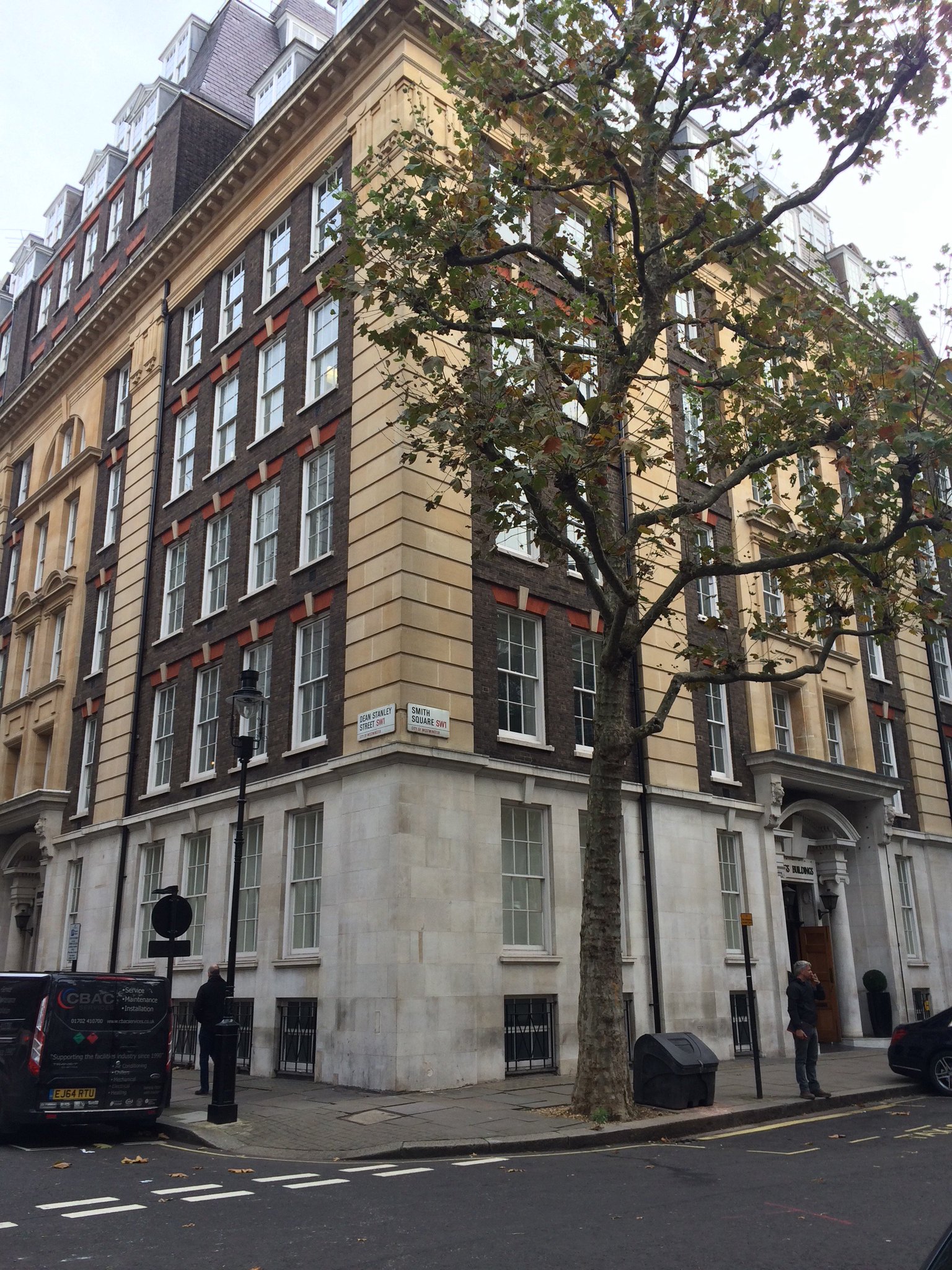
Radio Atlantico del Sur broadcast from the studios of the British Forces Broadcasting Service (BFBS) in Kings Buildings, Smith Square, just a few minutes walk from Parliament Square.

(Signs above the two entrances to the premises describe it as "Kings Buildings" i.e. with an s at the end of both words, but no apostrophe. On the internet, references can also be found to it as King's Buildings, King's Building and Kings Building.)

Shortly before the Falklands War, BFBS came under the control of a new organisation, the Services Sound and Vision Corporation, SSVC, a registered charity which also took over the running of cinemas and the provision of live entertainment for British forces overseas.

The BFBS name continued to be used on air, as it does to this day.

But documents in the MoD files generally use the term SSVC.

For example, a letter of 6 May from Sir Frank Cooper, permanent under secretary at the MoD, to Sir Antony Acland, his opposite number at the FCO, outlining the plans for Radio Atlantico del Sur, said:
Material would be produced in London at the studios of Services Sound and Vision Corporation.
(Sir Frank wrote his letter, setting out the plans and objectives for RAdS, in the hope of securing Foreign Office support for the project. That was a forlorn hope. The FCO was firmly opposed to RAdS from the start. Sir Antony hastened to reply to Sir Frank the same day so hastily that his letter contains a spelling mistake to tell him that "there are considerable doubts here about the project".)

What was in Kings Buildings?

More details of what was planned at Kings Buildings are given in the key SPG 020 document mentioned above. A slightly revised version of SPG 020, dated 29 April, said:

Studio facilities can easily be made available in Kings Buildings close to the Services Sound and Vision Corporation (SSVC) whose studios can be used outside working hours without interference with normal work. This will be adequate at least in the early stages, and enhancement will be possible. We are examining provision of: (a) Telephones, (b) Commercial Telex, (c) A single broadcast-quality 'music' line to BBC Bush House together with a pair of 'talk-back' lines.
Later in the same document, when setting out the proposed budget for RAdS, it is explained that provision would need to be made for payment of "overtime for SSVC staff".

The reference to studio facilities "close to" the SSVC needs examination. In a separate MOD document, written after the Falklands War, the Radio Atlantico del Sur team were said to have been "fortunate to find spare office space readily adjacent to the broadcasting studio". I assume therefore that RAdS staff used both BFBS's studio and other rooms within Kings Buildings.


The requirement, in point (c) of the passage above, for a "broadcast-quality 'music' line" to Bush House (then the HQ of the BBC External Services) would have been based on the assumption that a feed of Radio Atlantico del Sur would need to go via Bush House in order to be relayed to the Ascension Island transmitter, which beamed the station to its target audience.

As explained in my post The Incident at Crowsley Park on the Night of 20-21 May 1982, in the end the BBC was not involved in relaying the RAdS feed to Ascension. Instead it was relayed via BT's Rugby Radio Station, which would have received a feed by landline direct from Kings Buildings.

Some remaining mysteries

There is an intriguing paragraph in ffrench-Blake's memoirs in which the eventual location of the station's studios is hiding in plain sight. He says that, just a few days after the Argentine invasion of the Falklands (2 April 1982), when he was working at a radio station at a ski resort in the French Alps, he received a "mysterious" telephone call
asking me to ring a certain number in the Ministry of Defence. I made the call, and a very polite officer asked me if I could report to Room 2009 on the second floor of the Kings Buildings within, “say, 48 hours or so”.
This suggests that the SPG may have already been working in Kings Buildings in early April, well before the RAdS team was assembled.

Possible further evidence for this suggestion is in a memo in the MoD files dated 3 June (i.e. almost two months later, but while the Falklands War was still in progress). The memo appears at first sight as a routine circular such as one sees in all workplaces. In it, the head of the SPG reports various personnel movements in his team, with team members joining and leaving, gives the phone numbers of the new staff, and says "... the normal duties of the SPG members now dictate that they work in future from their normal offices as opposed to Room 5346 in the [MoD] Main Building [off Whitehall]".

Might, I wonder, their "normal offices" have been in Kings Buildings?

A curious document and a strange denial

After considerable delay, caused by Whitehall wrangling, the War Cabinet gave the go-ahead for Radio Atlantico del Sur on 18 May – almost three weeks after the Special Projects Group had issued its initial SPG 020 proposal.

The following morning the MoD issued a press statement giving some details of the new radio station. The statement formed the basis for widespread coverage in the British press.

Along with the text of the press release and a fairly straightforward question-and-answer brief for journalists (e.g. "Q: Surely the station will be propagandist?" – "A: No. Programmes will be factual"), the FCO file on Project MOONSHINE also contains a curious document entitled:

ADDITIONAL DEFENSIVE BRIEFING FOR RADIO ATLANTICO DEL SUR
This paper appears in the FCO file alongside the main press release and Q&A briefing, but uses a slightly different layout and looks as if it was typed on a different typewriter. Most of the seven "defensive" points are unremarkable (e.g. "Will any of the announcers be women?" – "Yes, some will be") but then there is this one:
Q. Is the British Forces Broadcasting Service involved?
A. No.
This flat-out denial is odd, contradicting the usual principle of "only lie when you have to". As far as I recall, no suggestion was made by the press that BFBS was involved, and I've not found reference to any such suggestion in the files.

Also in Kings Buildings at the time

While Radio Atlantico del Sur used BFBS's studio for its live broadcasts (which were at midnight to 0300 and 0930-1030 British Summer Time), BFBS continued its own work. This included recording its daily broadcast to British forces in the South Atlantic which I described in my post "BFBS Calling the United Kingdom Task Force".

So, the same studios were being used on a daily basis for separate services to British and Argentine forces!
Dean Stanley Street to the left. Smith Square main entrance on the right

Kings Buildings  today

BFBS/SSVC moved out of Kings Buildings in 1984 to an address in Paddington, and later to its current base just outside London in Chalfont St Peter, Buckinghamshire.

On a recent visit, I found no signage outside Kings Buildings (16 Smith Square) or in its lobby to indicate its current tenants. It is known, however, that DEFRA (Department for Environment, Food & Rural Affairs) occupies part of the building. DEFRA is based next door in Nobel House (17 Smith Square). Smith Square is a prime location for political lobbyists, and it is no surprise that a web search shows that among the other tenants of Kings Buildings are the National Farmers' Union (NFU) and the Chemical Industries Association.


The main entrance to Kings Buildings is on Smith Square. A separate entrance around the corner in Dean Stanley Street is now closed. The 1982 edition of the World Radio TV Handbook gives BFBS's address as "King's (sic) Buildings, Dean Stanley Street" – suggesting that its studios may have been on that side of the building.


Kings Buildings looks as if it would have been a convenient and pleasant workplace for the staff of Radio Atlantico del Sur. Despite being so close to parliament (and only 10 minutes walk from the MoD Main Building), Smith Square is quiet. Nearby Victoria Tower Gardens, overlooking the Thames, would have provided a patch of green for a break from work for RAdS staff in that early summer of 1982.


Notes

[1] In a previous post I noted that ffrench-Blake's surname took some time to acquire its hyphen. It was still hyphenless in his 1982 CV but has a hyphen in his 1995 book South East Asia Golf Guide and in his memoirs, The Pol Pot Conspiracy, published in 2015 (the year before his death)For the sake of consistency I am giving it a hyphen throughout this blog.

© 2017. Material may be reproduced if attributed to Chris Greenway and any original source.
Sunday, 1 October 2017

"BFBS Calling the United Kingdom Task Force"

This post was amended on 22 October 2017 to update the information on when SSVC took charge of BFBS. See the subsection "Operator".

Disclaimer: I was employed by the BBC at the time of the 1982 war, and continue to be so. However, this is an entirely personal blog post, reflecting only my views.


About this blog post: When I began this blog I intended to focus exclusively on Radio Atlantico del Sur, the Spanish-language shortwave station operated by the British Ministry of Defence in the final four weeks of the April-June 1982 Falklands War. Later, I felt that to tell the story of RAdS to the fullest I needed to look also at some other radio broadcasts during the 1982 war. 


So, I devoted one post to Argentina's Liberty station. 


In the post below I look at a service run by the British Forces Broadcasting Service (BFBS). Although apparently modest, it was an innovative development that is very poorly documented. And if something is undocumented it will eventually disappear.


It is paradoxical that this BFBS service, which operated openly and was given publicity in the British press, now has a far smaller internet footprint than either Radio Atlantico del Sur or Liberty, which were both, to varying extents, clandestine operations and which both probably had smaller audiences in their core targets than the BFBS programmes.


Thus, Google searches for the specific phrases (within quotes) "bfbs calling the task force", "bfbs calling the uk task force" or "bfbs calling the united kingdom task force" all produce no results at all (though I hope that will change after the publication of this post).

Fortunately, I still have my private diary and logbook from 1982 which contain notes of the internal BBC operational instructions for the BFBS service. These, together with some other material already in the public domain, are the sources for this post.

Sarah Kennedy presented the BFBS show for the Task Force


"BFBS Calling the United Kingdom Task Force" – profile of a morale-boosting service

Summary: A short programme, aired daily for most of its life, and consisting, in its own words, of "requests and messages from family and friends at home".


Target audience: British servicemen in the South Atlantic during, and for a month after, the 1982 war.


Name and on-air identification: In an article in 2012 to mark the 30th anniversary of the war, BFBS's official historian Alan Grace refers to the service as the "Task Force Request Programme".


This name is also used, though misspelled, by the Imperial War Museum's online archive which –unhelpfully for electronic searches – refers to the show as the "Task Forces (sic) Request Programme" (three entries in the IWM database) and the "Task Forces Requst (sic) Programme" (one entry).


"Task Force Request Programme" may have been the working name used within BFBS, but the opening identification used on the air was: "This is BFBS, the British Forces Broadcasting Service, calling the United Kingdom Task Force."


And "BFBS Calling the United Kingdom Task Force" – often shortened to "BFBS Calling the Task Force" – is the name I remember from 1982, both at work at BBC Monitoring and privately as a shortwave radio enthusiast.


Operator: The British Forces Broadcasting Service (BFBS). 

In early 1982, before the Falklands crisis, BFBS operations came under the control of a new organisation, the Services Sound and Vision Corporation, SSVC, a registered charity which also took over the running of cinemas and the provision of live entertainment for British forces overseas. But the BFBS name continued to be used on air, as it does to this day.


First broadcast: Monday 26 April 1982.


Last broadcast: Friday 16 July 1982.


Total number of broadcasts: 76 over the course of almost 12 weeks (as explained below, broadcasts didn't become daily until 7 May).


Programme content: Record requests and personal messages for named British servicemen. To maximise the number of messages aired in the short time available, records were not played in full.

Alan Grace's article says more than 7,000 requests were aired over the life of the programme.


A note in the June 1982 edition of Navy News invited requests to be sent to: Task Force Requests, BFBS London, PO Box 1234.


Presenters: The main presenter was Sarah Kennedy, who had begun her career at BFBS in the 1970s. By the time of the 1982 war she was known in Britain as one of the hosts of the ITV show Game for a Laugh.

Nicol Raymond, a presenter on BFBS TV, joined Kennedy after the show went daily.


A number of celebrities made guest appearances. They included the broadcaster David Hamilton and glamour model Fiona Richmond


Duration of programmes: When launched, each programme lasted for 30 minutes. When the broadcasts became daily on 7 May the duration was cut to 25 minutes. This may have been necessary to fit in with the scheduling of BBC transmitters.


Transmission schedule: Initially aired three days a week (Monday, Wednesday, Saturday) at 1100-1130 GMT on two shortwave frequencies: 21490 and 17830 kHz (in the 13- and 16-metre bands respectively).


From Friday 7 May it became a daily broadcast, at the slightly later time of 1130-1155 GMT, and went out on just one frequency, 15105 kHz (changed to 15180 kHz from 11 June) in the 19-metre shortwave band. 


This retiming was to allow for the introduction of an extra broadcast (at 1100-1130 GMT, i.e. early morning in Latin America) by the BBC's Spanish for Latin America service, which had previously only been on the air in the evening, Latin America time.


From 18 June (four days after the Argentine surrender) the BFBS service was retimed to 1400-1425 GMT and the frequency was changed to 17870 kHz. I don't know the reason for this second retiming. It may have been in response to feedback from the Task Force that a later time would be more convenient for the audience.


Production arrangements: The programmes were recorded at BFBS's central London studios in Kings Buildings, Dean Stanley Street, Westminster. The tapes were then taken to Bush House, HQ of the BBC External Services, for transmission over BBC facilities.


Transmission arrangements: These were handled by the BBC External Services. For internal BBC scheduling purposes, the service was colour-coded Pink. [1]


The service was beamed to the South Atlantic on the above shortwave frequencies from 250-kilowatt transmitters at the BBC Atlantic Relay Station on Ascension Island.


The programme was fed from the UK to Ascension by two BBC independent-sideband (ISB) transmitters, on 22930 kHz (from Daventry, Northamptonshire) and 26490 kHz (from Rampisham, Dorset). Between 26 April and 17 June these feeds were relayed instantaneously by the Ascension station. Between 18 June and 16 July the feeds continued to go out from the UK at 1130 GMT, but were recorded at Ascension to be aired at 1400 GMT the same day. [2]


Argentine response:
No Argentine jamming of the BFBS broadcasts was heard (unlike other transmissions from Ascension by the BBC and Radio Atlantico del Sur). 


In his Media Network programme on Radio Netherlands on 6 May 1982, a week after the BFBS service was launched, Jonathan Marks suggested that the operators of Argentina's Liberty station were monitoring it to glean the names of British servicemen with the Task Force, so that they could use the details in their own broadcasts.

Alan Grace says all letters to be read out on the air were "carefully checked for any form of information which might have been of some use to the Argentinians". However, the names of individual service personnel were given along with their specific ship, so there was plenty for Liberty's monitors to jot down.


Conclusions


By today's standards, "BFBS Calling the United Kingdom Task Force" was a very modest affair.


But in 1982 it was quite a revolutionary development. Up to then, BFBS had only operated what were in effect local radio stations in places where British forces were based overseas.


The network of stations varied over the years with changes in military deployments, and in 1982 there were just four BFBS stations: in West Germany, Cyprus, Gibraltar and Hong Kong. These ran a local live service, heavily supplemented by recorded material prepared at BFBS HQ, recordings of BBC programmes and live relays of BBC news.


Although BFBS had its HQ, with studios, in London, it ran no stations for forces' members or their families in the UK. And with no shortwave service it was not heard by a global audience.


This was in contrast to its US equivalent, the Armed Forces Radio and TV Service (AFRTS) which ran an extensive shortwave operation, using transmitters of the Voice of America (VOA), mainly for ships at sea. I frequently listened to AFRTS on 15430 kHz, which was well heard in the UK for much of the day, with programming mainly consisting of relays of the US domestic networks ABC, CBS and NBC.


BFBS's appearance on shortwave in 1982 was short-lived. But the idea of transmitting BFBS via shortwave to British forces was revived in both the 1990-91 and 2003 Iraq campaigns.

Notes

[1] All BBC external services (either individual languages or groups of them) were colour-coded for ease of reference throughout the signal chain from studio to transmitter (which might be thousands of miles apart, with some broadcasts airing over many transmitters in multiple locations). For example, the main World Service in English was always coded Green. Arabic was always Brown and Russian was Grey. And so on. The evening Spanish and Portuguese transmissions to Latin America were coded Red (as was the BBC's "Calling the Falklands" programme), though the additional morning Spanish transmissions mentioned above were, like the BFBS ones, coded Pink.

[2] Two simultaneous feeder frequencies were used so as to provide "diversity reception" at Ascension. This could reduce the effects of shortwave fading by allowing at any one time for the stronger feeder of the two to be selected for the programme relay.

Initially, the BFBS programme was carried on upper-sideband (USB) on both feeder frequencies. Later, this was switched to lower-sideband (LSB). This may have been because when a BBC feeder transmitter was operating in ISB (independent-sideband) mode, Green (i.e. BBC World Service in English) was generally carried on USB and the other programme (in this case BFBS) on LSB.

© 2017. Material may be reproduced if attributed to Chris Greenway and any original source.